





Lasersec Technologies

QR code packaging improving patient engagement in pharma

How smart pharma packaging is transforming patient engagement, safety, and brand trust.

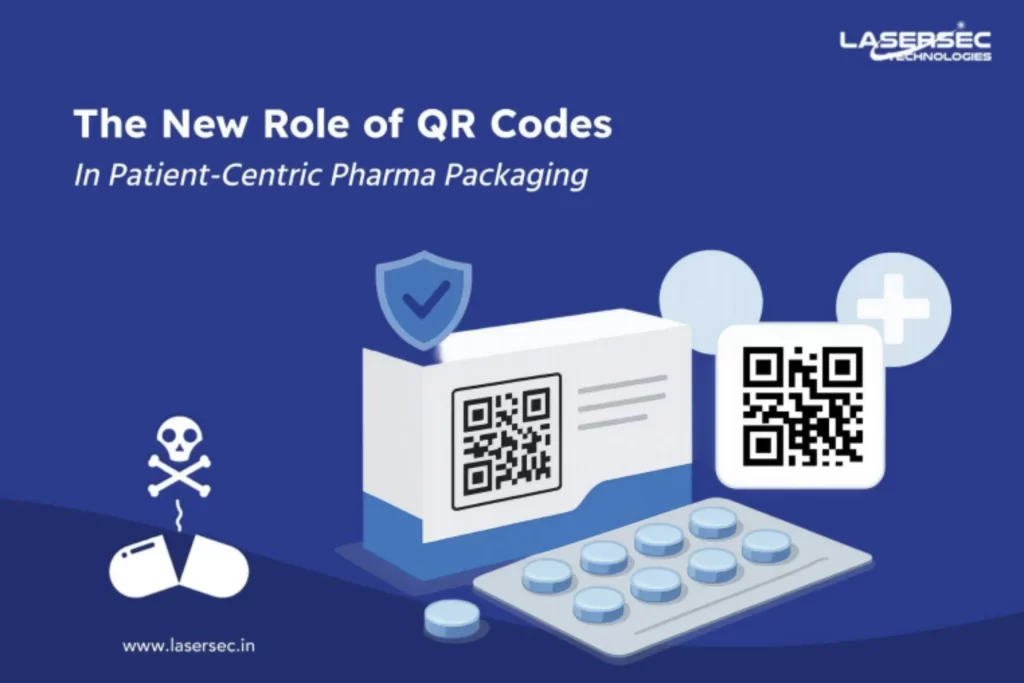
QR codes are reshaping the way pharmaceutical brands connect with patients. What once served as a simple tool for authentication has now evolved into a gateway to information, transparency, and trust.

Today’s patients expect more — they want packaging that not only protects but also guides, educates, and supports. This shift marks the rise of patient-centric pharma packaging, where every scan becomes an opportunity for connection and care.

Turning Every Scan into a Smart Pharma Experience

Each QR code scan now opens a digital window of clarity and support.

With one scan, patients can instantly access:

  • Dosage and usage instructions
  • Multilingual digital leaflets
  • Expiry, batch, and manufacturing details
  • Easy reorder and refill links
  • Direct customer support channels
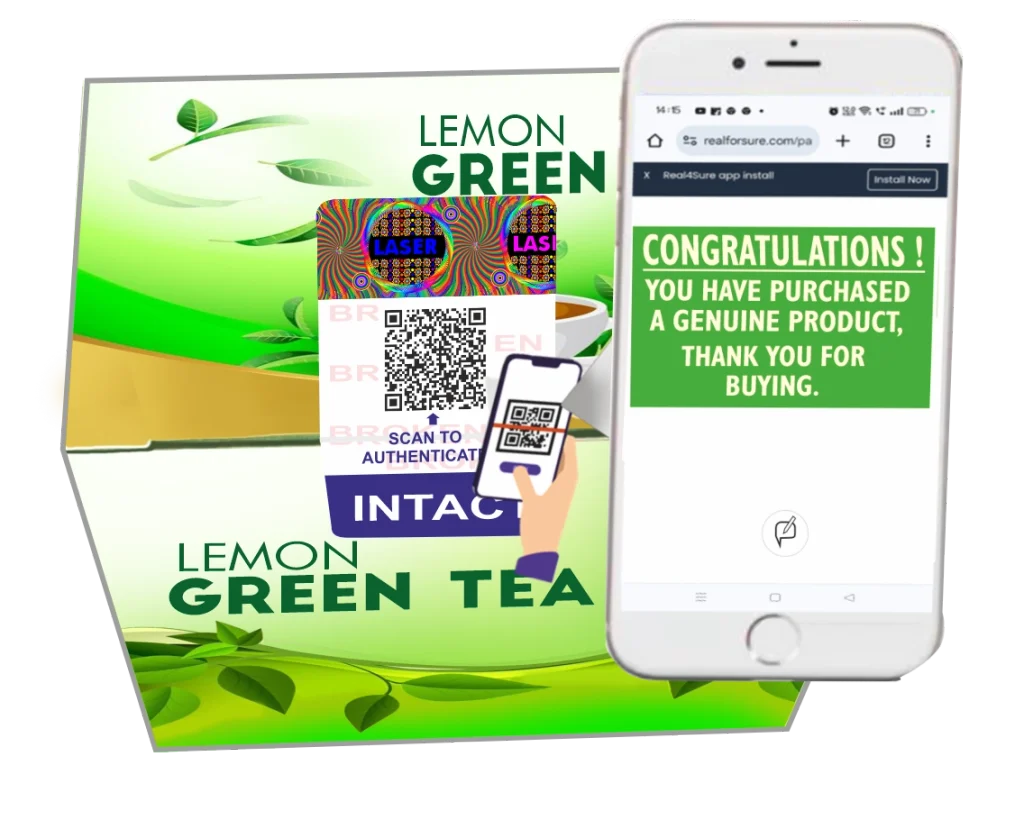
  • Instant product authentication

Every interaction replaces uncertainty with confidence — turning static packaging into a smart, helpful, and patient-friendly experience powered by Track & Trace Technology.

Making Healthcare More Accessible and Inclusive

In a diverse market like India — and across global regions — accessibility is key. Printed leaflets can be limiting, especially for patients with visual impairments, language barriers, or low literacy.

QR-based pharma packaging makes information universally available. Patients can:

  • Watch explained videos in their preferred language
  • Read digital leaflets with enlarged text
  • Access audio or visual dosage guides
  • Learn safe medicine usage anytime, anywhere

For senior citizens and patients managing chronic conditions, this digital inclusion ensures safe, confident, and independent medication use.

Empowering Pharma Brands Through Transparency

For brands, the benefits go far beyond compliance. Smart QR integration empowers pharmaceutical companies to:

  • Build patient trust through transparent, verifiable data
  • Enable post-purchase engagement via digital refills and reminders
  • Reduce leaflet printing costs and packaging clutter
  • Collect anonymized insights on product usage (while protecting patient privacy)
By merging authentication, traceability, and engagement, brands transform packaging into a platform for education, loyalty, and lasting care — supported by Anti-Counterfeit Labels with QR Code.

Future-Proofing with Compliance and Sustainability

With evolving mandates like India’s Pharma QR Code Directive and the EU’s Digital Product Passport, digital-first packaging is no longer optional — it’s the new standard.
 

QR-enabled packaging allows brands to:

  • Stay compliant with serialization and Track & Trace systems
  • Simplify global exports with adaptable, multilingual labels
  • Reduce paper waste through digital leaflets — supporting sustainability goals
  • Streamline verification processes for regulators and distributors

It’s a smart, sustainable, and compliant way to protect both patients and the brand.

Technology That Builds Trust — Not Distance

In an era of increasing digitization, human connection must remain central. When used meaningfully, QR codes don’t create distance — they strengthen it.

Each scan becomes a symbol of care, offering immediate access to help, clarity, and reassurance. Behind every code is a message that says: “This brand is here for you.”

Explore how Lasersec Phygital Solutions bridge the gap between physical packaging and digital engagement — keeping patient trust at the heart of every innovation.

How Lasersec Technologies Helps Pharma Brands Lead with Smart QR Solutions

At Lasersec Technologies, we specialize in helping pharmaceutical brands upgrade to intelligent, secure, and globally compliant QR-based packaging systems.

Our solutions combine:

  • GS1-compliant serialization for global traceability
  • Encrypted authentication layers for anti-counterfeit protection
  • Patient engagement portals for real-time education and support

From factory to pharmacy, we enable brands to meet regulatory standards while building transparency and trust at every step.

Reach out to us via our Contact Page or call +91-9810213127 to learn how our QR solutions can help your brand deliver smarter, safer, and more patient-centric experiences.
Share :

Frequently Asked Questions

QR codes transform traditional medicine packaging into an interactive information hub. By scanning a code with a smartphone, patients can access dosage instructions, digital package inserts, product authentication, multilingual resources, and support information, making medicines easier and safer to use. Discover how dynamic QR codes are the gateway to real-time consumer assurance in pharmaceutical packaging, and learn how innovations in pharmaceutical packaging design are using QR Code Authentication and Track & Trace Technology to put patients first.

Yes. QR codes linked to secure authentication platforms allow patients, pharmacies, and distributors to verify whether a medicine is genuine. When integrated with serialization and Track & Trace Technology, they help detect suspicious products, improve supply chain visibility, and strengthen brand protection. See how phygital packaging stops counterfeit medicines through instant QR-based verification, and explore our Anti-Counterfeit Labels with QR Code solutions for enhanced pharmaceutical security.

Smart QR-enabled packaging supports patient education, simplifies access to digital information, enhances transparency, reduces dependence on printed leaflets, and enables post-purchase engagement. It also helps manufacturers meet evolving regulatory and traceability requirements while improving the overall patient experience. Learn how the shift from traditional labels to interactive packaging is transforming pharma brands, and explore how combining QR-based authentication with Phygital Solutions creates a more connected healthcare journey.

Yes. Digital QR-enabled packaging can support serialization initiatives, Track & Trace programs, multilingual information delivery, and digital documentation while reducing paper-based inserts. This helps manufacturers adapt to changing compliance requirements and sustainability goals without compromising patient access to important product information. Explore how smart label technology meets EU Digital Product Passport and serialization compliance and learn more about our Track & Trace Technology and Phygital Solutions.

An effective solution should provide secure authentication, GS1-compatible serialization support, seamless integration with Track & Trace systems, scalable patient engagement capabilities, and protection against counterfeiting. It should also enable secure access to digital product information and support future regulatory needs. Learn how personalized pharma packaging combines dynamic QR codes, smart labels, and patient-specific authentication and explore our QR Code Authentication, Track & Trace Technology, and Phygital Solutions to build a smarter packaging strategy.

Related Blogs

High-security packaging for injectable drugs

Injectable medicines are among the most critical products in modern healthcare.

From oncology therapies and vaccines to biologic and emergency medications, injectable drugs are used in situations where treatment accuracy and product integrity are essential.

Unlike many oral medications, injectable drugs enter the bloodstream directly. Any compromise in authenticity or quality can pose immediate risks to patient safety.

Yet despite strict pharmaceutical regulations, counterfeit injectables continue to appear in global supply chains.

In many cases, counterfeiters replicate packaging components such as vials, ampoules, and outer cartons so convincingly that visual inspection alone cannot confirm authenticity.

For manufacturers of sterile and injectable medicines, protecting packaging integrity has therefore become a critical part of product safety.

This is why high-security pharmaceutical packaging, including tamper-evident labels, holographic authentication features, and Track & Trace systems, is rapidly becoming essential for injectable drug protection.

Why Injectable Medicines Are Prime Targets for Counterfeiters

Injectable drugs are often high-value therapies used in hospitals, clinics, and specialized treatment centers.

Many injectable medicines are expensive due to complex manufacturing processes, sterile production requirements, and regulatory approvals.

These factors make injectable drugs particularly attractive targets for counterfeit operations.

Common targets include:

  • Oncology injections
  • Vaccines and biologic
  • Emergency injectable medicines
  • Hormone therapies
  • High-value specialty injectables

Counterfeiters may attempt to replicate packaging components or refill genuine containers with non-genuine substances.

Because injectable packaging formats such as vials and ampoules are relatively small, counterfeit versions can sometimes enter distribution channels without immediate detection.

The consequences of counterfeit injectables can be severe:

  • Ineffective or dangerous treatments
  • Patient safety risks
  • Hospital supply chain disruptions
  • Regulatory investigations and recalls
  • Loss of trust in pharmaceutical brands

The Unique Packaging Challenges of Injectable Medicines

Injectable medicines typically use packaging formats such as:

  • Glass vials
  • Ampoules
  • Pre-filled syringes
  • Sterile containers

These packaging types must maintain strict sterility and product stability.

However, their small size and simple structure can also make them vulnerable to tampering or counterfeit replication if additional security features are not integrated.

For example:

  • Vials may be refilled with counterfeit substances
  • Ampoules may be replicated using similar glass formats
  • Labels can be copied or replaced
  • Outer cartons may be duplicated

Because injectable products are frequently handled in clinical environments, ensuring secure and verifiable packaging is essential.

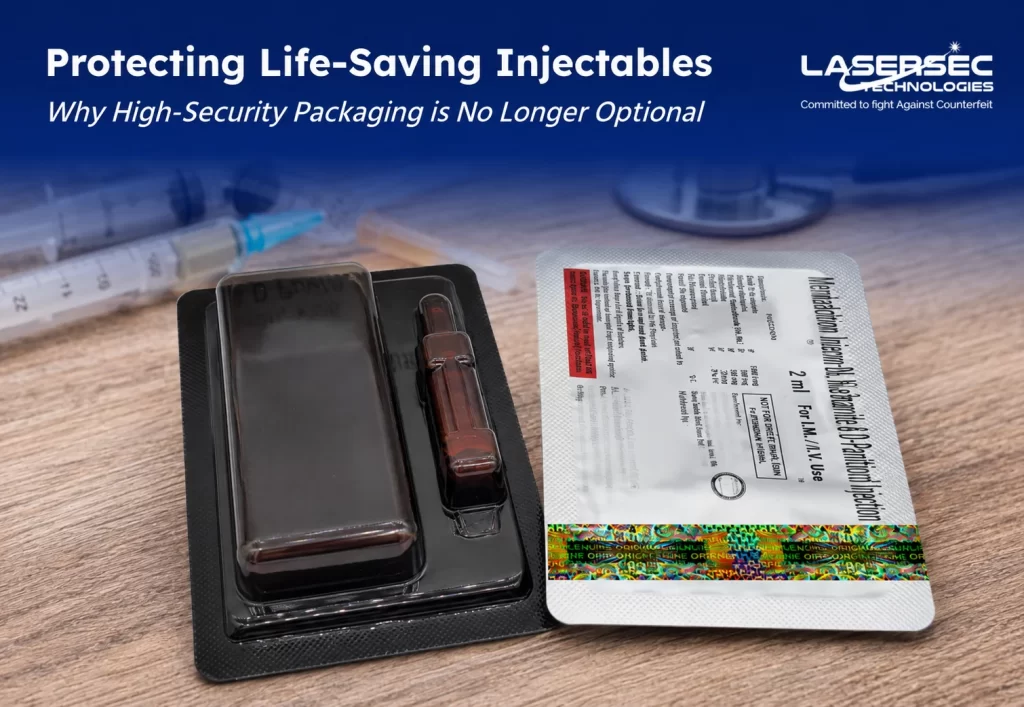
The Role of Tamper-Evident Labels in Injectable Packaging

Tamper-evident labeling is one of the most important protective mechanisms for injectable medicines.

These labels are designed to clearly reveal if a vial, ampoule, or outer packaging has been opened or altered.

Tamper-evident features may include:

  • Destructible labels that break when removed
  • VOID security indicators that appear during tampering
  • Adhesive residues that reveal interference
  • Security cuts that prevent clean label removal

Once triggered, these labels cannot be restored to their original state.

This allows healthcare providers, pharmacists, and distributors to immediately detect whether a product may have been compromised.

Strengthening Authentication with Holographic Security Features

Holographic security elements provide an additional layer of protection against counterfeit packaging replication.

Unlike traditional printing, holograms are produced using specialized optical technologies that create dynamic visual patterns.

These patterns change appearance when viewed under different lighting conditions.

For pharmaceutical packaging, holographic labels help:

  • Provide visible authentication for distributors and healthcare providers
  • Deter counterfeit packaging replication
  • Enhance brand identification on sterile packaging

Because holographic features require specialized manufacturing capabilities, they are extremely difficult for counterfeiters to reproduce accurately.

Securing Vials and Ampoules with High-Security Labeling

High-security labels can be applied directly to injectable packaging components such as:

  • Glass vials
  • Ampoule containers
  • Injection cartons
  • Sterile packaging seals

These labels serve multiple purposes.

They provide tamper evidence, authenticate the product visually, and help protect the packaging from unauthorized opening or substitution.

When applied strategically, security labels ensure that any attempt to alter the packaging becomes immediately visible.

This strengthens product integrity across distribution channels.

Integrating Serialization and Digital Verification

In addition to physical packaging security, many pharmaceutical manufacturers are implementing serialization and digital authentication systems.

Serialized identification codes allow each product unit to carry a unique digital identity.

These codes may be integrated through:

  • Data matrix codes
  • Serialized QR codes
  • Unique product identifiers linked to authentication platforms

When scanned, the system can verify whether the product matches its registered identity within a secure database.

If duplicate codes appear or if products are detected in unauthorized locations, the system can immediately flag potential counterfeit activity.

Improving Supply Chain Security for Injectable Drugs

Injectable medicines typically move through tightly controlled pharmaceutical supply chains that include manufacturers, distributors, hospitals, and pharmacies.

Despite these controls, supply chain vulnerabilities can still occur.

High-security packaging helps strengthen supply chain protection by enabling:

  • Immediate detection of tampering
  • Easier authentication for distributors and regulators
  • Better traceability through serialization systems
  • Faster identification of suspicious products

This visibility helps pharmaceutical companies prevent counterfeit injectables from reaching healthcare environments.

Why Injectable Drug Manufacturers Are Adopting High-Security Packaging

Manufacturers of sterile pharmaceutical products are increasingly recognizing that packaging security is directly connected to patient safety and regulatory compliance.

High-security packaging provides several advantages:

  • Protection against counterfeit injectables
  • Clear tamper evidence for sterile packaging
  • Improved authentication for healthcare providers
  • Integration with serialization and Track & Trace systems
  • Stronger regulatory confidence and brand protection

For life-saving injectable medicines, these protections are becoming essential rather than optional.

How Lasersec Technologies Supports Secure Injectable Packaging

At Lasersec Technologies, we develop advanced anti-counterfeit packaging and labeling solutions designed to protect high-risk pharmaceutical products.

Our high-security solutions combine tamper-evident labeling, holographic authentication technologies, and serialization-ready packaging features to secure injectable medicines throughout the supply chain.

These solutions help pharmaceutical manufacturers:

  • Protect injectable drugs from counterfeiting
  • Secure vials and ampoules against tampering
  • Strengthen packaging authentication
  • Support regulatory compliance and serialization
  • Improve supply chain transparency

By integrating advanced security technologies directly into pharmaceutical packaging, we help ensure that life-saving medicines reach healthcare providers and patients safely.

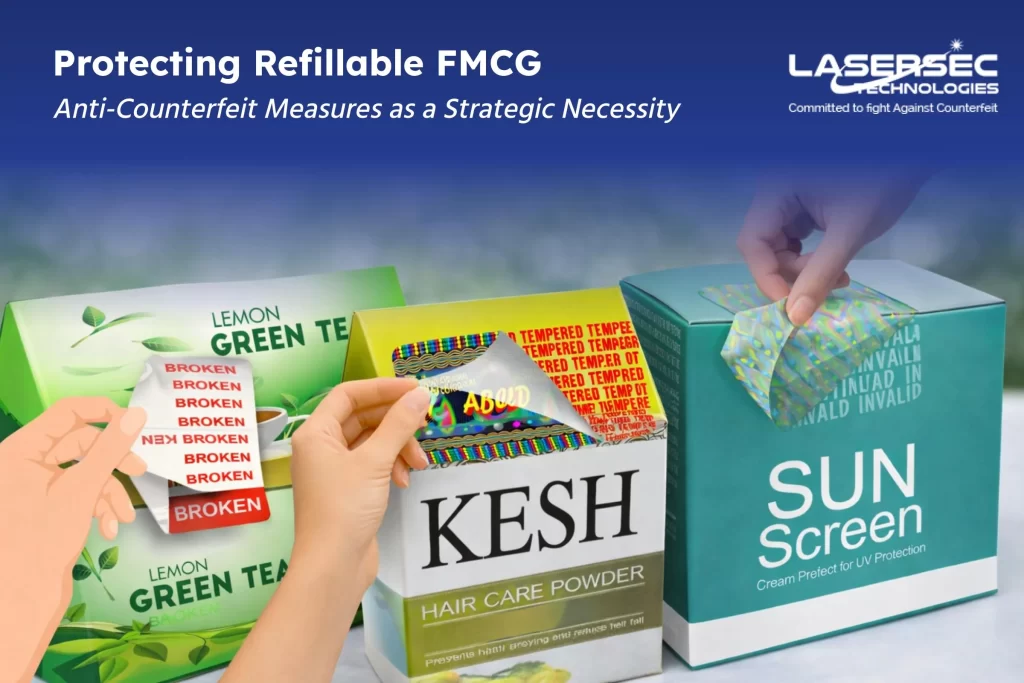
Anti-counterfeit packaging for refillable FMCG products

Sustainability is becoming a major priority for FMCG brands worldwide.

Many companies are redesigning packaging systems to reduce plastic waste, minimize environmental impact, and encourage circular consumption models.

One of the most widely adopted approaches is refillable packaging.

Consumers purchase a durable container once and then refill it with product pouches, sachets, or refill packs. This model significantly reduces packaging waste and supports long-term sustainability goals.

However, while refillable packaging improves environmental performance, it also introduces new security challenges.

Refill packs and reusable containers can become targets for counterfeit products if authentication mechanisms are not integrated into the packaging system.

For FMCG brands focused on sustainability innovation, ensuring both environmental responsibility and product authenticity is becoming increasingly important.

The Rise of Refillable Packaging in the FMCG Industry

Refillable packaging systems are becoming increasingly common across FMCG categories such as:

  • Personal care products
  • Household cleaning products
  • Liquid detergents
  • Beauty and skincare products
  • Food and beverage concentrates

In these systems, consumers typically purchase a primary container that is designed for repeated use.

Refill packs allow the consumer to replenish the product without discarding the main container.

This model offers several sustainability benefits:

  • Reduced plastic consumption
  • Lower packaging waste
  • Reduced transportation impact due to lighter refill packs
  • Improved lifecycle efficiency for packaging materials
While these advantages are significant, refillable systems also create new vulnerabilities for product authenticity.

The Counterfeit Risk in Refillable FMCG Products

In refill-based systems, the original container often remains in use for a long period of time.

Consumers rely on refill packs to maintain product quality and performance.

However, counterfeiters may attempt to exploit this system by introducing fake refill packs or unauthorized refilling practices.

Some common risks include:

  • Counterfeit refill pouches imitating branded refill packs
  • Unauthorized refill stations offering diluted or fake products
  • Reused containers filled with non-genuine formulations
  • Repackaged counterfeit products sold as genuine refills

Because consumers already possess the original container, they may assume that any refill product associated with that brand is authentic.

Without authentication features, distinguishing genuine refills from counterfeit ones becomes extremely difficult.

Why Traditional Packaging Security May Not Work for Refill Systems

Traditional anti-counterfeit strategies often focus on protecting the primary product packaging.

However, refill systems change the structure of product distribution.

Instead of purchasing a completely new packaged product each time, consumers rely on secondary refill formats.

These refill packs are often:

  • Smaller
  • Flexible pouches or sachets
  • Lightweight packaging formats

Because refill packs are designed to reduce material usage, they may contain fewer physical security elements.

This creates opportunities for counterfeiters to replicate packaging designs more easily.

For FMCG brands investing in sustainability-driven packaging systems, security must evolve alongside sustainability initiatives.

The Authentication Challenges of Reusable Containers

Reusable containers present another layer of complexity for product authentication.

Since the primary container may remain in use for months or even years, the container itself does not necessarily verify the authenticity of the product inside.

A consumer may refill the container multiple times, but there is no guarantee that the refill used is genuine.

Without proper authentication mechanisms, several issues can arise:

  • Consumers unknowingly using counterfeit refills
  • Diluted or substandard products affecting performance
  • Negative brand experiences caused by fake formulations
  • Difficulty tracing product origin
In such scenarios, the brand may still be blamed even though the counterfeit refill was not produced by the manufacturer.

Integrating Authentication into Refill Packaging

To address these risks, FMCG brands are increasingly integrating authentication technologies directly into refill packaging systems.

These technologies help verify product authenticity while maintaining the sustainability advantages of refill models.

Common authentication solutions include:

These features allow consumers, retailers, and manufacturers to confirm that the refill product originates from an authorized source.

How QR-Based Authentication Supports Refillable Packaging

QR code authentication is particularly well suited for refill packaging because it requires minimal packaging material while enabling powerful verification capabilities.

Each refill pack can carry a unique scannable QR code linked to a secure authentication system.

When scanned, the system can verify:

  • Whether the refill product is genuine
  • Manufacturing origin and batch details
  • Product authenticity status
  • Brand verification information

This creates a simple verification process that consumers can perform using their smartphones.

If duplicate scans or suspicious activity occurs, the system can flag potential counterfeit distribution.

Supporting Transparency in Sustainable FMCG Supply Chains

Consumers who choose refillable products are often highly conscious about sustainability and brand ethics.

These consumers value transparency regarding product origin, formulation quality, and environmental impact.

Authentication technologies allow brands to provide this transparency through digital engagement.

When consumers scan refill packaging, brands can share information such as:

  • Product authenticity confirmation
  • Sustainability commitments
  • Responsible sourcing practices
  • Product usage guidance
This interaction strengthens consumer trust while reinforcing the brand’s sustainability messaging.

Why Sustainability and Security Must Work Together

Sustainability innovations should not compromise product security.

If refill systems are vulnerable to counterfeit infiltration, the consequences can include:

  • Consumer safety concerns
  • Product performance failures
  • Damage to brand credibility
  • Loss of consumer trust in refill systems

Therefore, packaging innovators and sustainability leaders must design refillable packaging systems that balance environmental responsibility with authentication security.

Integrating anti-counterfeit technologies ensures that refillable models remain safe, reliable, and trustworthy.

How Lasersec Technologies Supports Secure Refillable Packaging

At Lasersec Technologies, we help FMCG brands integrate authentication and anti-counterfeit protection into modern packaging systems.

Our solutions combine secure holographic labels, QR-based authentication, tamper-evident packaging features, and Track & Trace systems to protect products across evolving packaging formats.

These technologies help FMCG brands:

  • Prevent counterfeit refill products
  • Protect reusable container ecosystems
  • Enable consumer-level product authentication
  • Strengthen supply chain visibility
  • Support sustainable packaging strategies without compromising security

By integrating smart authentication technologies into refill packaging, brands can maintain both environmental responsibility and product integrity.