








Lasersec Technologies

Your Guide to Anti-Counterfeiting

Category: FMCG

Category: FMCG

In an age where food safety is paramount, the battle against counterfeit goods extends far beyond luxury items and into the very sustenance we consume daily. Anti-counterfeit solutions are no longer a luxury but a necessity, particularly in safeguarding the integrity of our food supply chain. From farm to fork, the risk of adulteration threatens not only consumer health but also the reputation of brands and the stability of entire industries.

The Growing Threat of Food Adulteration

Food adulteration is a global concern that knows no borders. From diluted olive oil to fake spices, the spectrum of adulterated products is vast and alarming. Not only does this undermine consumer trust, but it also poses significant health risks, ranging from mild allergic reactions to severe illnesses.

Detecting Adulteration: The Need for Advanced Technologies

Traditional methods of detecting food adulteration often fall short in the face of increasingly sophisticated counterfeit practices. This is where advanced anti-counterfeit technologies come into play. By leveraging a combination of physical and digital solutions, these technologies offer a multi-layered approach to detecting and preventing adulteration at various stages of the supply chain.

1. Product Packaging Authentication

One of the frontline defenses against food adulteration lies in product packaging authentication. Advanced security features such as holographic labels, QR codes, and RFID tags enable consumers and stakeholders to verify the authenticity of a product instantly. These features serve as visible deterrents to counterfeiters while empowering consumers to make informed purchasing decisions.

2. Track-and-Trace Technologies

Track-and-trace technologies provide invaluable insights into the journey of a product from its point of origin to its final destination. By implementing barcode scanning and GPS tracking, manufacturers can monitor the movement of goods in real-time, thereby identifying anomalies and potential points of adulteration along the supply chain.

3. Blockchain Technology

Blockchain technology offers a decentralized and immutable ledger that records every transaction within a supply chain. By leveraging blockchain, stakeholders can trace the origin of ingredients, verify their authenticity, and ensure compliance with regulatory standards. The transparency afforded by blockchain not only enhances trust among consumers but also facilitates swift and targeted responses to incidents of adulteration.

Collaborative Efforts and Regulatory Compliance

The fight against food adulteration requires a concerted effort from all stakeholders, including governments, regulatory bodies, manufacturers, and consumers. Regulatory compliance serves as a cornerstone in this endeavor, with stringent standards and guidelines governing the production, packaging, and distribution of food products. Collaboration between public and private sectors is essential in fostering innovation and driving the adoption of advanced anti-counterfeit solutions.

In a world fraught with counterfeit threats, the need for advanced anti-counterfeit solutions in safeguarding food integrity has never been more pressing. By embracing innovation, fostering collaboration, and upholding regulatory compliance, we can fortify the defenses of our food supply chain against the scourge of adulteration.

We, Lasersec Technologies, are leading anti-counterfeit solutions manufacturers that can secure the supply chains, protect the brand reputation, and ensure consumer safety. Together, let us ensure that the food we consume nourishes our bodies and sustains our trust for generations to come.

If you’re a manufacturer or business and looking for smart packaging for your products, look no further than us. We have the knowledge, experience, and expertise to help you to find the best solution that works for your business.

Reach out to us to discuss and our team will provide you with tailored solutions and support to make the process as smooth as possible. We also One Stop Solution to fight against counterfeit and create a more secure environment for your business. With less counterfeiting, you can maintain sales and increase customer trust.

Stay proactive, stay vigilant, and invest in the right anti-counterfeit solutions to ensure a counterfeit-free future.

About Lasersec Technologies

We are one of the leading holographic solutions manufacturing company, that are used as an anti-counterfeiting device. Our R&D team from the production area is constantly dedicated to finding innovative solutions against counterfeits. Thus, we proudly emphasize on the fact that all our solutions are original ones without any interference from any other outside companies. We have successful business alliances located in Bangladesh, South Africa, Malaysia, Sri Lanka, Nepal, United Kingdom, and countries of Europe.

You can reach us via email at mktg@lasersec.in or by phone at +91-9810213127.
Counterfeit products are becoming an increasingly pervasive problem in today’s global marketplace. From luxury goods to everyday items, counterfeiters are producing and selling fake versions of products at an alarming rate. This poses a significant risk to businesses of all sizes, as counterfeit products not only hurt their bottom line but also damage their reputation and customer trust. 

Unfortunately, many business owners hold misconceptions about the impact of counterfeiting on their operations, leading them to believe that they are not at risk. 

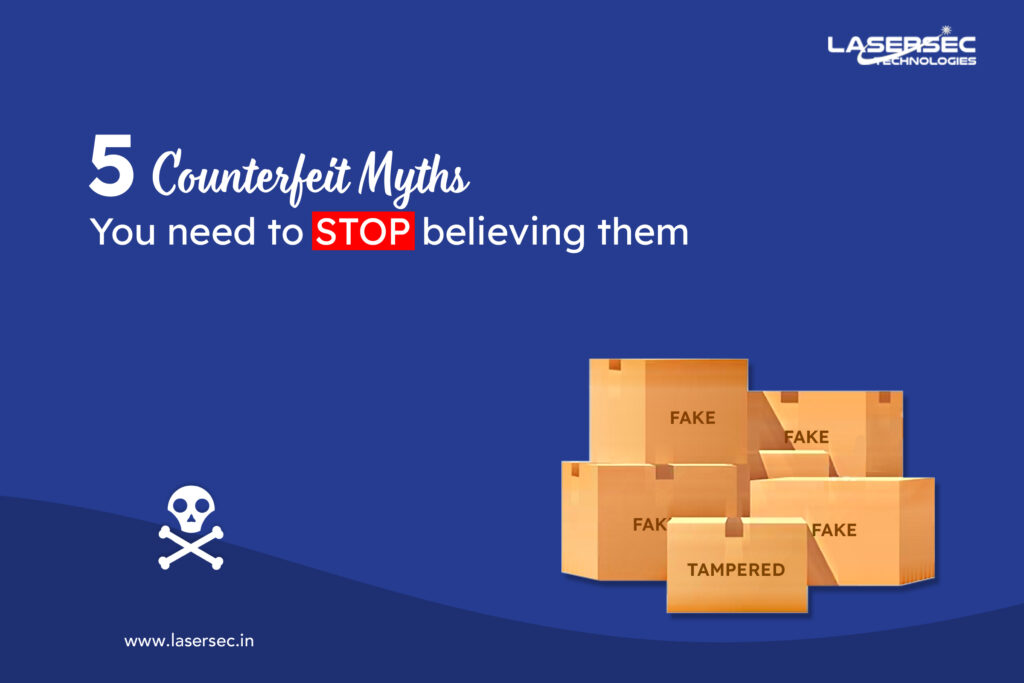
In this blog post, we’ll debunk five common myths about counterfeit products and explain how they can harm your business.  By understanding the realities of counterfeiting and taking proactive steps to prevent it, businesses can protect themselves from the potentially devastating consequences of this illegal activity.

Myth 1:

Counterfeit products only affect big brands.

One common misconception about counterfeit products is that only big brands are at risk of counterfeiting. In reality, small and medium-sized businesses are also at risk. Counterfeiters don’t discriminate based on the size of the company. Any business with a product that is in demand is a potential target for counterfeiters.

For example, a small clothing company that sells popular designs could easily be targeted by counterfeiters looking to make a quick profit. This could lead to a loss of revenue, as well as damage to the company’s brand reputation.

Myth 2:

Counterfeit products only impact revenue.

Another common myth about counterfeit products is that they only impact a company’s revenue. In reality, counterfeiting can also damage a company’s brand reputation and customer loyalty. When customers purchase counterfeit products that are of inferior quality or don’t meet their expectations, they may associate those negative experiences with the legitimate brand.

For example, a consumer who purchases a counterfeit phone charger that fails to work could assume that the legitimate brand’s products are also unreliable. This can lead to long-term damage to a company’s reputation and loss of customer loyalty.

Myth 3:

Only products that are expensive or have high profit margins are counterfeited.

Some companies believe that only high-priced products or those with high profit margins are at risk of counterfeiting. However, counterfeiters can target any product, regardless of its price point or profit margin. In fact, low-cost products can be especially attractive to counterfeiters, as they can sell them at a high volume while still making a profit.

For example, counterfeiters have been known to produce low-cost items such as phone cases, jewelry, medicine, tyres etc. which can be sold in large quantities for a high profit margin.

Myth 4:

Only companies that manufacture products overseas are at risk of counterfeiting.

Another common myth is that only companies that manufacture products overseas are at risk of counterfeiting. However, counterfeiting can occur anywhere in the supply chain, from manufacturing to distribution to retail.

For example, a retailer that purchases products from a third-party supplier may unknowingly sell counterfeit products to customers, which can lead to reputational damage and loss of customer trust.

Myth 5:

There’s no way to prevent counterfeiting.

Finally, some companies may believe that there’s no way to prevent counterfeiting. While it’s true that it’s difficult to completely eliminate counterfeiting, there are steps businesses can take to reduce their risk.

Investing in secure packaging solutions, such as hologram stickers or tamper-evident labels, can make it more difficult for counterfeiters to replicate products. Working with trusted manufacturers like us can also help ensure that the products being sold are legitimate.

We at Lasersec Technologies, recommend by understanding the realities of counterfeiting and take steps to protect the operations, businesses to reduce the risk of financial and reputational harm. Don’t let these common myths hold your business back from taking action against counterfeiting.

If you’re a manufacturer or business and looking for smart packaging for your products, look no further than us. We have the knowledge, experience, and expertise to help you to find the best solution that works for your business.

Reach out to us to discuss and ur team will provide you with tailored solutions and support to make the process as smooth as possible. We also One Stop Solution to fight against counterfeit and create a more secure environment for your business. With less counterfeiting, you can maintain sales and increase customer trust.

Shield your business with our advanced technology solutions

About Lasersec Technologies

We are one of the leading holographic solutions manufacturing company, that are used as an anti-counterfeiting device. Our R&D team from the production area is constantly dedicated to finding innovative solutions against counterfeits. Thus, we proudly emphasize on the fact that all our solutions are original ones without any interference from any other outside companies. We have successful business alliances located in Bangladesh, South Africa, Malaysia, Sri Lanka, Nepal, United Kingdom, and countries of Europe.

You can reach us via email at mktg@lasersec.in or by phone at +91-9810213127.
In today’s global marketplace, businesses face a growing threat from counterfeiters who seek to profit from the sale of fake products. Counterfeit goods not only damage a business’s reputation and bottom line, but they can also pose serious risks to public health and safety. 

As a result, companies are increasingly turning to anti-counterfeit solutions to protect their products and consumers. However, not all anti-counterfeit solutions are created equal, and businesses need to consider customization to effectively meet their unique needs.

Customized anti-counterfeit solutions offer businesses numerous benefits, including enhanced security, improved brand protection, and increased consumer trust. By tailoring anti-counterfeit technologies to their specific needs, businesses can improve product authentication, track their products throughout the supply chain, and monitor potential vulnerabilities. 

(more…)

Business of all sizes and in all sectors are impacted by the global problem of counterfeiting. It involves the production of fake goods that infringe on a company’s intellectual property rights, including trademarks, copyrights, and patents. 

Counterfeit products not only damage a brand’s reputation but also pose serious health and safety risks to consumers. As a result, businesses need to take proactive measures to protect their brand and customers from counterfeiting. Selecting the right anti-counterfeit solution for your business is crucial.

(more…)

Bangladesh is a country that has been struggling with counterfeiting for many years. Counterfeiting in Bangladesh is not limited to any particular industry. It affects everything from pharmaceuticals to electronics to clothing. Counterfeit products are often sold through unauthorized channels such as street vendors, online marketplaces, and even legitimate retail outlets.

(more…)